Do you have an emergency supply kit or a disaster supply kit? If not, get one – stat. Sometimes these emergency supplies might be all you have to keep you and your loved ones fed, hydrated, and warm should anatural disaster strike or during emergencies like severe winter weather and other weather hazards.
And September is National Preparedness Month, which is the ideal time to double-check the contents of your disaster supply kits, review expiration dates on food storage items and medical supplies, and ensure your 72-hour kit is complete with essentials from your disaster supply kit list.
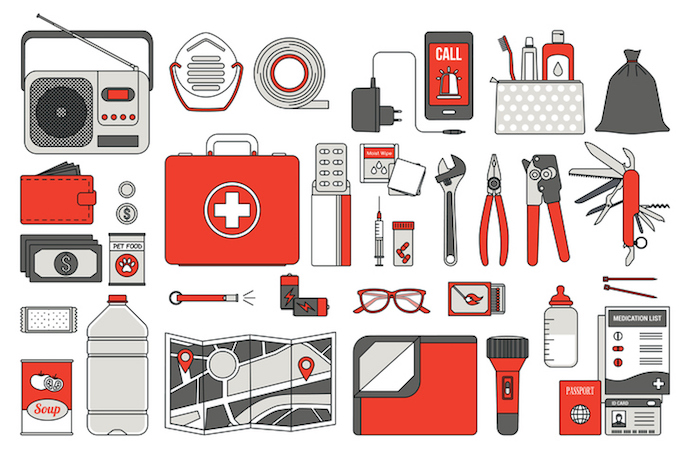
Your home emergency supply kit should include non-perishable food, a first aid kit, an emergency food supply, pet food (if applicable), a manual can opener, a NOAA weather radio or a battery-powered radio, personal medications, first aid supplies, a water storage tank or container, and a local map.
But assuming you have one at the ready (if not, stop reading here and get it put together, please!), where should you keep it?
Here are some tips for how to make your emergency kit as accessible as possible.
How to Store Your Supplies
Keep your emergency supplies in a portable container, such as a grab-and-go bag, backpack, duffel bag, durable plastic container made of food grade plastic (BPA Free preferred), stackable bucket with lid, or roller suitcase and store it in a location that is easily accessible in case you have to evacuate your home quickly, advises Don Lauritzen, communications officer for the American Red Cross. Consider using collapsible, compact, lightweight tools to save space in your survival kit or bug-out bag.
Best Places to Store Your Kit
Where are those places in your house?
“The best or worst place to store an emergency preparedness kit is entirely dependent upon the kind of emergencies that might occur in the geographical area in question,” points out Alexander Ruggie of 911 Restoration, which specializes in recovery after disasters.
For example, he says, it may be logical to store an emergency kit under the kitchen sink in Denver, but in New Orleans, this may end up under an entire building’s worth of water if there is a major flood.
When assembling your preparedness kit, consider creating multiple disaster supply kits for different locations. A comprehensive 72-hour kit should include emergency supplies like non-perishable food, water storage tanks, medical supplies including first aid supplies and personal medications, a fire extinguisher, battery-powered radio or NOAA weather radio, and other items from your supply list. Check expiration dates regularly on food storage items, especially freeze-dried fruit and other emergency food supply products, to maintain shelf life.
Among the prime spots recommended by the American Red Cross for your home emergency supply kit and disaster supply kits are:
- In a closet or storage space near an exit (store your grab-and-go bag or duffel bag here);
- Under your bed (ideal for a 72-hour kit in a duffel bag);
- In the garage, in a stackable bucket or container – especially practical since it would be close to your car if you need to evacuate;
- But watch for emergency food supply items, water containers, and pet food freezing in severe winter weather.
I keep our main emergency supply kit and preparedness kit in a hall closet that I also keep stocked with extra blankets, batteries, flashlights, water containers, and bottled water,” says Rebecca Tarrant of Charlotte, NC, who adds that she also keeps an infant and child emergency kit in her child’s room with age-appropriate medical supplies and first aid supplies.
Anywhere that’s too inconvenient, such as the attic, is a non-starter, though. Although we often picture ourselves riding out the disaster in our home, the attic may not be a convenient location if you have to evacuate quickly, Lauritzen says.
Multiple Stashes
The safest approach to storing an emergency preparedness kit is to create more than one disaster supply kit, and keep them in separate areas of the home prepared for different emergency situations and weather hazards, notes Ruggie.
For example, to be extremely protected, keep one disaster supply kit with food storage items and a fire extinguisher in the garage, another grab-and-go bag under the kitchen sink with first aid kit and non-perishable food, and another disaster supply kit in an off-site location like a storage unit (in a duffel bag or stackable bucket) or with a friend on the other side of town,” he says.
And make sure all household members know where the kit is stored.
Beyond the Home
Two other places to consider adding disaster supply kits are:
- In a storage facility (store duffel bags with emergency food supply, water storage tanks, and food storage items);
Pro Tip: Is your storage facility near your home? It’s a smart idea to put a duplicate in the unit, in case you are caught outside your neighborhood and can’t return.
- In your vehicle (vehicle emergency kits in a bug-out bag or duffel bag)
Pro Tip: Having a kit in your car is advised, in case you are out and about when disaster strikes. Roads can quickly become clogged, and traffic flow could be cut off.
Tarrant stows a disaster supply kit in her car that she updates seasonally for severe winter weather preparedness, replacing summer clothes with heavier winter clothing, as well as swapping out food storage items, non-perishable food, freeze-dried fruit, emergency food supply, and water in water containers that may be close to their expiration dates. She also checks the shelf life on all items regularly.
It’s also a good idea to keep a few emergency supplies like a first aid kit, battery-powered radio, manual can opener, non-perishable food, and a local map in your commuter bag or grab-and-go bag,” Lauritzen suggests, or in your desk at your workplace as part of your emergency preparedness strategy.
The More You Know…
Not sure what to do in case of an emergency? Find out how to prepare for and what to do during an emergency with the American Red Cross Emergency App. It also offers a choice of a variety of severe weather alerts for your area and that of your extended family.
Make Self Storage Part of Your Emergency Plan
While having emergency kits strategically placed throughout your home and vehicle is essential, self storage can play a valuable role in your overall disaster preparedness strategy. A climate-controlled self storage unit provides an ideal off-site location for maintaining backup supplies that won’t take up precious space in your home. Consider storing duplicate emergency kits, extra water storage tanks, bulk non-perishable food items, seasonal supplies, and important document copies in a secure storage facility near your neighborhood.
This approach ensures you’ll have access to critical supplies even if your home becomes inaccessible during an emergency. Just remember to choose a storage facility on higher ground if you live in a flood-prone area, keep your unit organized for quick access, and update your stored supplies at least twice a year to check expiration dates and refresh seasonal items. By incorporating self storage into your emergency preparedness plan, you’re creating an additional safety net that could prove invaluable when you need it most.